Cloud Strategy • Workload Optimization
Published April 2026
~
AI workloads scale with compute in a way traditional workloads don’t. The optimization strategy that works for one systematically underserves the other.
AI Workloads Have Different Economics
At the heart of AI workloads is a defining property: they are designed to run in parallel. GPUs are built for this — thousands of cores working simultaneously, purpose-built for the kinds of calculations that power modern AI.
For sufficiently parallel workloads, doubling compute can approach doubling throughput. The job finishes in half the time. And critically, cost per unit of work can remain roughly constant — not always, not perfectly, but often enough that the smart question shifts from "how do I spend less?" to "how much acceleration can I get, and what is that worth?"
Harnessing parallelism is not just dependent on the number of cores. It also requires rapid access to GPU memory (VRAM) which means VRAM size and VRAM bandwidth are important as well. If the model or dataset doesn't fit in VRAM, the GPU stalls waiting for data. If VRAM bandwidth is too low, the cores sit idle even though the work is there. Getting the right speedup means matching compute, VRAM size, and VRAM bandwidth together — not just maximizing core count.
Cost optimization makes sense for many traditional workloads because these workloads have, at best, limited parallelism to exploit. Thus, adding more compute does not translate to better throughput, at scale. While key workloads could still benefit from a limited amount of additional compute despite additional cost, less important workloads are optimized for cost per unit time.
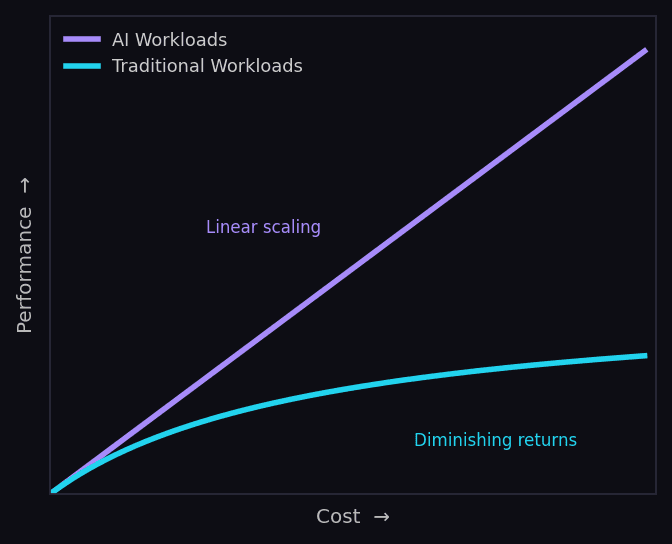
Performance vs. compute cost: AI workloads scale linearly; traditional workloads show diminishing returns.
"For AI workloads, faster execution doesn't mean a higher cost per unit of work. That's the break from traditional workload economics — and why smart optimization for these workloads looks completely different."
An Illustrative AI Workload Optimization Example
For any given workload, Serra Labs searches across potentially millions of configurations to find the best one for each of three objectives: minimize cost while holding a performance floor, maximize throughput within a cost guardrail, and find the best cost-to-performance tradeoff between the two. The following example shows what that looks like in practice — three recommendations for a real AI prompt-to-video workload, derived from analysis of its historical behavior.
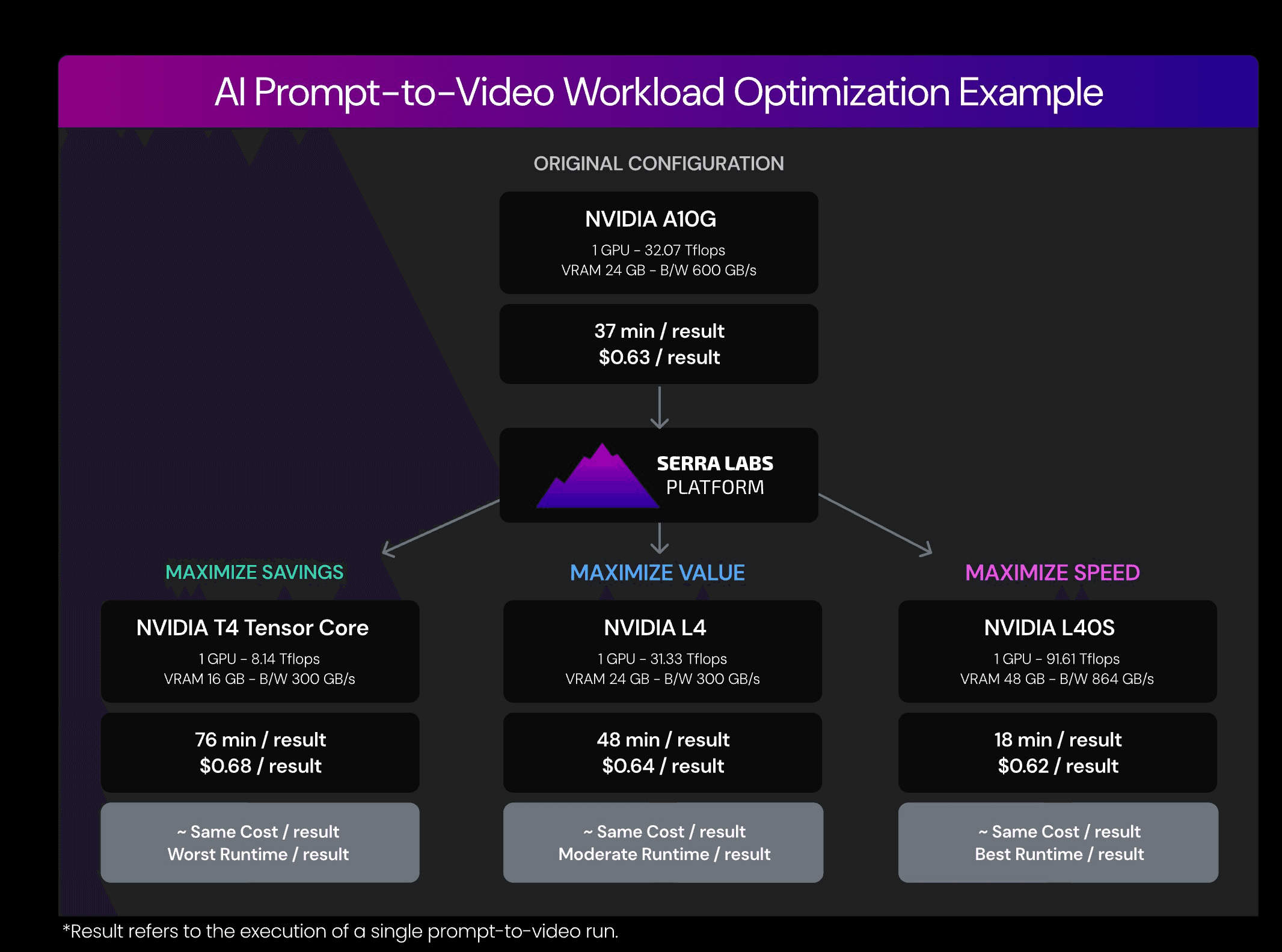
Starting from the original A10G configuration, the Serra Labs Platform searches millions of alternatives and recommends the optimal GPU for each of three objectives. Cost per result is essentially the same across all three — only time per result differs.
The three configurations shown are recommended by the Serra Labs Platform for an AI prompt-to-video workload, based on analysis of its historical behavior. Looking only at cost per day, the cost-optimal recommendation appears attractive — it is the cheapest option. But cost per day is the wrong metric for an AI workload. What matters is how much work gets done. Viewed from a throughput perspective, the performance-optimal configuration is clearly superior: significantly more work completed in the same period. And critically, cost per unit of work — the number that actually captures efficiency — is roughly the same across all three objectives. Spending less per day with the cost-optimal configuration does not save money. It just means the same money buys fewer results and a longer wait for the team to iterate.
This AI workload optimization insight is fundamentally fueled by two factors — (i) most AI workloads are massively parallel and (ii) GPUs are priced such that cost per unit of work associated with an AI workload is essentially flat across GPU configurations.
What Smart Cloud Spend Looks Like for AI Workloads
The world of cloud workloads is rapidly changing with AI coming to the fore. Whereas cost optimization is considered the smart approach for many traditional workloads, it is performance optimization that is best suited for most AI workloads. In such a world, having the ability to choose between strategies for each workload is paramount.
Lifecycle of AI workloads does play into this. In the development and prototyping phase, cost optimization would be better — runs of the workload may be fewer and spread out, so spending less per day is a reasonable trade-off. In the validation and testing phase, value optimization makes more sense as runs increase and tend to be more consecutive, where balancing cost and throughput matters. When in production, performance optimization is the right call: runs may be consecutive and sustained, driven by real users, and response time becomes critical.